Time and time again I’ve heard musicians around me, of all skill levels, talk about how they are simply not interested in learning any music theory. Here’s the greatest hits of reasons why:
- It’s going to steal my soul
- It’s too much to think about
- I don’t want any “rules”
- It’s too hard to learn
- I can’t read music
- I like my playing just the way it is
And so on. But the thing is, they’re all missing the point entirely!
Why learn music theory?
Did you play or hear something that you like? Would you like to be able to play that again, in any key? Cool! Music theory is the solution for that. And here’s the catch: it doesn’t have to be super complicated. Even a very basic understanding of how this works provides you with a massive catalogue of sounds in your head that you can recreate any time and in any key.
At it’s heart, I think of music theory as a labelling system. It’s my personal filing cabinet of sounds that I know I love. Having that “filing cabinet” takes the pressure off of remembering that exact position, or chord shape, or riff, or what have you.
So let me walk you through one of my favorite applications of music theory, in the hopes that you’ll leave here with something you can use right away to up your creative game. We’re going to keep this as simple as possible, taking you step by step.
Keys, key signatures and the musical alphabet
What is a key?
A key is your tonal center. What feel like “home”? When a phrase ends and it feels like we’ve “landed”, what note or chord is that? That’s our key. Our home base.
Every key has its own “key signature”. The key signature tells us how many sharps or flats (aka “accidentals”) we’re going to encounter as we play. I’m not going to go into much detail here, as I’m very much trying to keep this surface level for you. For that reason, we’re going to be working in the key of C, which has no sharps or flats at all.
This means that our C major scale looks like this:
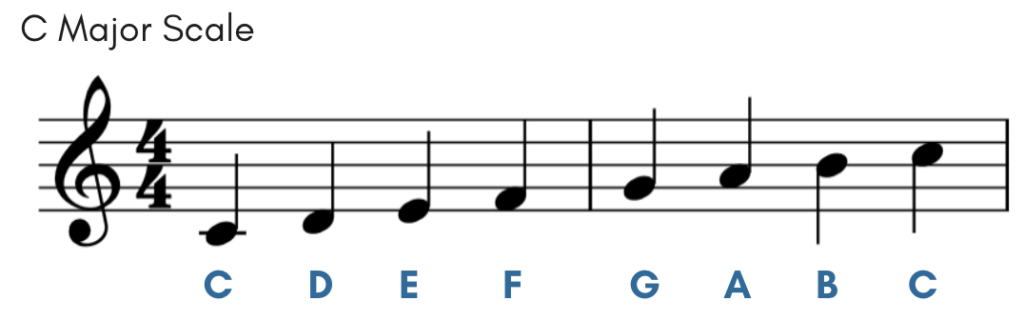
We start on C, and walk up the musical alphabet from there, using no sharps or flats. The musical alphabet, by the way, is just like the alphabet you’re already familiar with. However, it stops at the letter G.
So the musical alphabet looks like this:

Notes vs Chords
Now that we’ve found our C major scale, we figure out which chords go with each of those notes. By the way, let’s talk notes vs chords:
- A note is a single pitch, or a single tone. You can sing a note. A note could be one single key pushed on a piano, or one single string plucked on a guitar.
- A chord is two or more notes played at the same time. There’s some rules for this, but for now we’re going to stick with that definition.
Every scale step gets a number
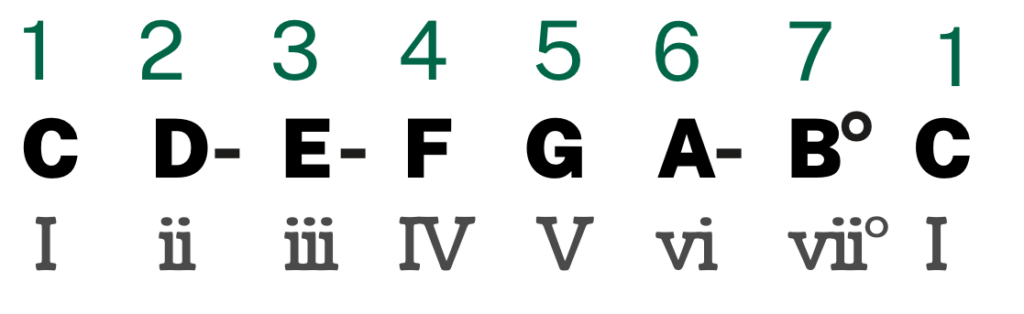
Every note of the scale gets a number, which is important to know for our next step. Here’s our C major scale again, labelled with numbers.

Can you count to 7? Can you recite the alphabet up to the letter G? You got this!
Every scale step gets a chord!
Ok, with that covered, let’s talk about the chord pattern that will line up with our C major scale. In a very convenient and quite magical way, this pattern does not change regardless of which key we’re in. Here’s that magical pattern:
1 4 and 5 are major chords
2 3 and 6 are minor chords
7 is a diminished chord
What the heck are major, minor and diminished? In an extremely simplistic but conceptually helpful way, here’s the breakdown:
- Major chords are happy, bright
- Minor chords are sad, dark (also thoughtful, beautiful, introspective!)
- Diminished chords are like minor, but more minor. A little sinister perhaps, but also very useful in some situations.
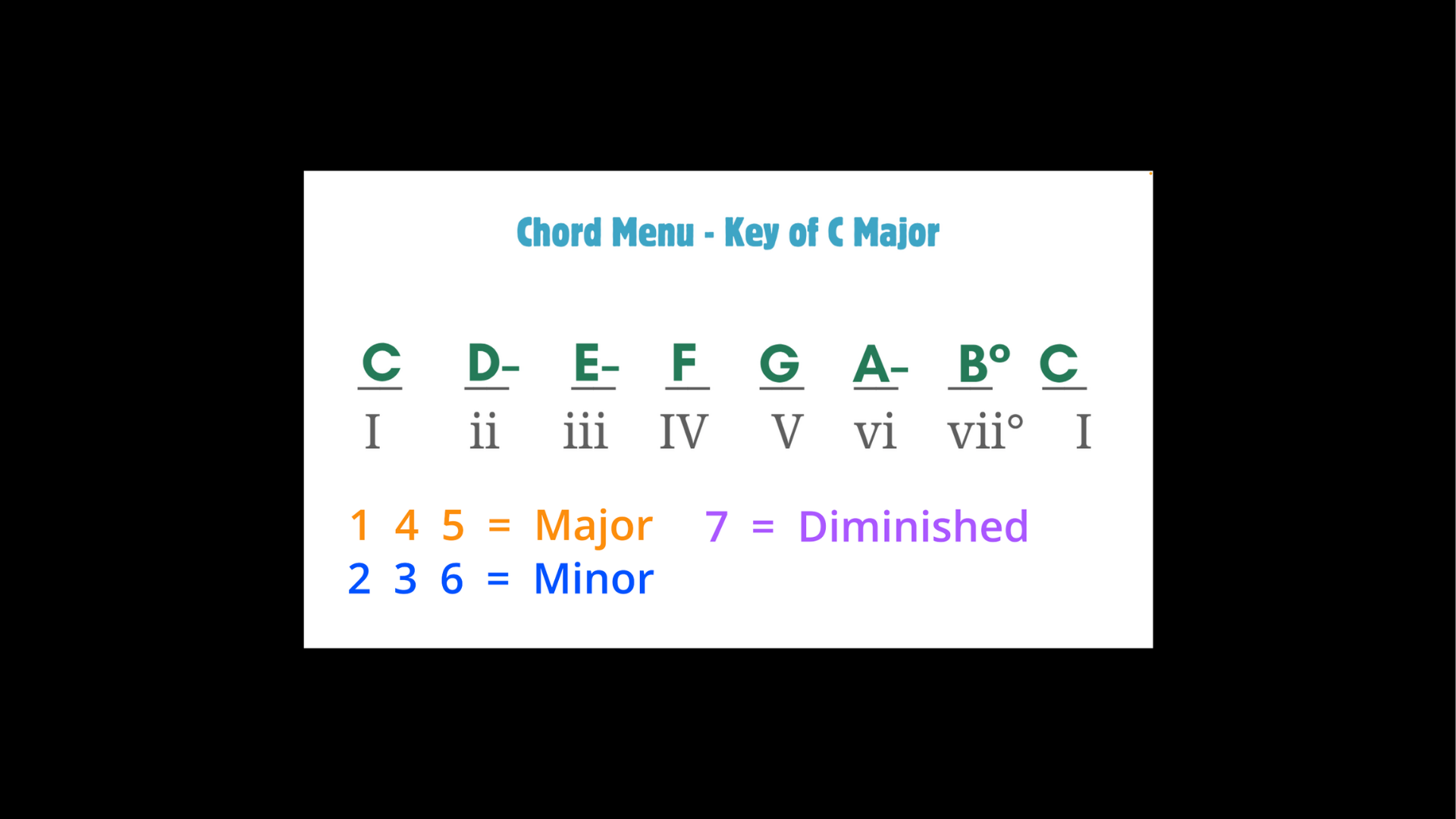
Moving back again to our C major scale, we’re now going to write out all of the chords that belong to the key of C. We use roman numerals when talking about chords, upper case for major, lower case for minor.
Music theory magic: Common chord progressions and the Chord Menu
And now we’ve come to my favorite part, and the lesson I’m hoping you walk away with here. Now we get to build chord progressions from our “chord menu”.
That list of chords above is more that just a curiosity. You can mix and match these chords in any order and it’s going to sound good. This is an immensely powerful bit of knowledge when you’re jamming, or writing music.
A quick note on the 7 chord
It’s worth noting that the vast majory of popular songs do not utilize the 7 chord. So much so, in fact, that we’re going to leave it off our menu entirely. Sorry 7 chord, you are not on the menu today.
The magic chords: 1 4 5 and 6
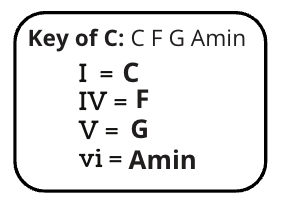
Let’s build some chord progressions right now. For starters, it’s good to know that the most common chords are 1 4 and 5, with the 6 chord close behind. There are many thousands of songs that use 1 4 5 only.
Here are those chords in the key of C:
Now, here are a few common chord progressions. Try these out and then come up with your own!
- I IV V
- I V IV
- I V
- I vi IV V
- IV V I vi
Truly, no matter which chord combinations you come up with, as long as you stick to the menu, you’re going to be fine. The freedom this provides to just play and focus on your musical expression is phenomenal. You can jam more freely and learn songs much more quickly, especially when your ear starts to recognize the sound of these patterns.
And by all means, don’t forget about the 2 and 3 chords! They’re not quite as common, but they’re great sounds and definitely worth exploring.
Just be sure to write down and try to memorize the number pattern of any chord progressions you come up with that you really like. That’s the start of that awesome musical treasure box in your brain.
Why numbers?
This questions actually gets to the heart of how powerful this really is. I’m going to strongly encourage you to start thinking of your chord progressions as numbers, and not chord names. Every song you write or learn can, and should, be thought of as chord numbers.
Why? Well, what if we needed to change the key? This could be necessary for a bunch of reasons, but here’s the two most common:
- The current key doesn’t work for the singer’s voice
- The current key isn’t great on your particular instrument
If you can only think of the song by its chord names, the process of translating those chords becomes quite a chore. For example, you’re always thinking “ok, it’s C in this key… but it needs to be a whole step higher so C turns into D, ok now that F chord turns into G, etc… etc…”
That is EXHAUSTING.
If instead you’re thinking in numbers, the process becomes much faster.
Say your chord progression goes I IV V I. Now, all you need to know is your key and you’re good to go.
I IV V I in C = C F G C
I IV V I in D = D G A D
And so on. You’re no longer “translating” anything, you’re just moving that same old familiar chord progression to a different key. It is so liberating to start thinking this way. It makes you an infinitely more flexible musician, and it lets you quickly knock out a task that can otherwise be tedious and stressful.
In Conclusion
If all you get from this is that chord menu above, it’s a win. I really wanted to just scrape the surface here and give you a taste of how powerful even a little bit of theory can be for your playing.
Knowing a key, the major scale and the chords that go with it gives you a leg to stand on. Want to jam without having to poke around in the dark until something sounds good? This has you covered. Want to learn songs very quickly by ear? Knowing the sound of these patterns is the trick to getting there.
And that brings me to my last point while we’re on this subject: 1 4 and 5 sound like 1 4 and 5 no matter which key you’re in.
That’s right. You can train your ear to recognize the sound of the 1 chord, the 5 chord, the 6 chord, the 3 chord, etc… Once you start paying attention to your chord numbers, you can and will start hearing these patterns everywhere you go.
Imagine hearing a chord progression in your head, and immediately recognizing what that progression is. How amazing is that!
That could be the difference between writing that song that’s in your head, or dropping it in frustration when you can’t find it and you lose the inspiration.
That could be the difference between dropping into that jam right where you want to, or suffering through a lot of trial and error before settling in.
Where do I go from here?
This was just the tiniest of introductions to a much bigger subject, but I hope I painted a picture of what’s possible here. If you’d like to learn more, you can continue to follow this blog(link) and subscribe to our YouTube channel(link), where theory will be a recurring subject.
You can (and should!) download our free key of C chord menu as a quick reference and to practice writing your own chord progressions.

And for a rock solid foundation in music theory for absolute beginners, we’ve created “Chord Summit” – a series of easily digestible music theory courses that take you from total beginner to proficient chord wizard.
And as always, keep climbing the mountain.
Leave a Reply