I’ve been teaching for a little over 17 years now, and one of the most impactful discoveries I’ve made is comprehending the power of songwriting as a learning tool.
So much so, in fact, that I’ve gradually turned my entire teaching practice towards songwriting as the primary vehicle for learning music.
Have I abandoned teaching cover songs? Absolutely not! It’s often a specific song or artist that inspires a student to come to the table in the first place. I will never stand in the way of that inspiration.
However, it is crystal clear to me that songwriting holds several advantages over a traditional “covers only” music education that makes the teaching and learning process easier, more joyful and more meaningful.
The challenges of cover songs
I’ll start by describing some of the pitfalls I’ve continuously run into over the years learning songs with kids. Here’s a few common scenarios:
- We learn the really fun main riff of a song, but never get to the rest of it.
- We can almost play the whole song, but the bridge has that one chord in there that’s really hard to play
- We can only play the song on our instrument in a key that doesn’t work for our voice
- We were inspired when we first started, but got bogged down somewhere and now we’ve lost interest and it just sort of… fizzles out
- It’s been 2 months and somehow we’re still grinding on this song and we still can’t play it.
I know any music teacher (and most music students) can relate.
Now, does running into one of those above scenarios mean that we never should have started that song? No! There might be a lot of value in learning that riff, or only singing the chorus of that song, etc..
In fact, when I sense us reaching the point of getting bogged down, you know what I do? I encourage us to thank that song for teaching us some valuable lessons, and move on. I don’t think enough teachers realize that this is a totally valid option. But I digress…
Yes, there could be plenty of value even in the above scenarios. But what if I told you there was a way to never run into any of those pitfalls?
The answer is songwriting.
Custom tailored to your learning needs
There are so many benefits to writing your own songs, but I’ll start with a very practical one from a learning perspective.
Your own original song is exactly what you need it to be.
Did you just start learning the guitar and you can only play two chords? Let’s write a song that uses those two chords to great effect. Are you currently focusing on your rhythm? Let’s write a song that challenges you in a highly specific way to think rhythmically.
As a teacher, you can build this in as you go. I have spent hours and hours searching for the “perfect” cover songs to meet my students where they are. It’s always hit or miss. Probably leaning towards miss if I’m being honest. There’s finding the song in the first place, then there’s getting buy-in from the student to embrace that song and hopefully enjoy it. It’s an uphill battle.
Not so with an original song. I can ensure as a teacher that this song we’re creating provides the lessons I think you need most, with virtually zero friction. And I can do it in the moment as it’s happening. This is solid gold.
A deeper connection: owning what you’ve learned
There’s no getting around the fact that learning anything involves hard work and vulnerability. It can be physically and emotionally taxing. It also requires upkeep. You want to keep revisiting those skills you’ve built – sharpening the tools, so to speak. When we’ve moved on from a song or a subject, how much is retained?
I first started to recognize the power of songwriting in my lessons when I caught on to the fact that my songwriting students were learning faster and retaining more through their original songs.
When you use your brand new skills to create something of your very own, it sticks better. You have an emotional connection to what you’re learning, and that emotional connection lives deep in your mind.
I see the youngest students absolutely light up when we write a one-chord song with lyrics and record it. They own that. There’s a pride and satisfaction there that just hits different. Years later I have students asking to listen to the songs they created 4, 5, 6 years prior. It becomes this roadmap of progress to which they are inextricably connected.
An expression-first approach
My goal as a music educator is to teach my students to speak the language of music fluently. There are many diverging paths to get there, and cover songs remain an important part of the journey. We have so much to learn by studying the masters.
That said, there are aspects of that fluency that songwriting emphasizes over cover songs.
Emotional expression is one of them. One of the great gifts of playing an instrument is having that play time to turn to when things become overwhelming or stressful. Give me 5 minutes on a drum set and I will absolutely feel better about anything and everything.
The act of creating your own music makes this a deeper connection. It’s hard to describe the mental space I go to when I’m improvising or working on a song. When I’m in that flow state, there’s much less room for outside distraction. One of my greatest hopes is that I can pass that on to my students. Songwriting is how we practice going to that place.
I mentioned improvising, and it’s worth noting that songwriting builds those improvising skills. You’re practicing creating your own melodies, chord progresses, grooves, moods. All of these skills make you a more fluent improviser, and more likely to be the one leading jams with your friends (and having more fun while you’re at it).
A case study
In the video above, I recount in detail the story of the first 4 lessons of one of my newest students. I won’t retell that all here verbatim, but I think it’s worth looking at in bullet points:
Day 1:
- He’s interested in drums, but he wants to explore several instruments.
- We start on the drum set with a really simple beat. We’re feeling what it’s like to play at a steady tempo. We’re finding beat 1, counting to 4, breaking things down into measures. This is a fun way for any student to learn these things – it’s a bonus that this student in particular is interested in drums.
Day 2:
- We continue counting, finding beats, feeling the rhythm, jamming together on drums and different instruments. I keep everything in the studio mic’d up and ready to record, so by the end of this lesson, we record a solid minute of him playing his first drum beat.
- We listen back to it, celebrating that awesome achievement of holding down a beat – making music in time.
Day 3:
- Next lesson we pick up a guitar and we were able to handle an Em chord. We get to push play again on his own recording of the drum beat and play along with that.
- I ask him: “If you could write a song about anything right now, what would it be?” He thinks for about 5 seconds and says “There’s this extinct giant snake called Titanaboa and it could weigh 2000lbs and….” (many many facts about this cool snake)
- So I say “can we sing the word ‘Titanaboa’ over that Em chord?” And he just GOES FOR IT. And it rocks.
- We quickly write a chorus with a couple of rhyming lines.
- We run to the whiteboard and start scribbling down lines about this snake. Every new snake fact gets a rhyming line to go with it.
- I get him to sing these lines right away, and I play the chords for him. I choose chords that I know will be easy enough for him to play on guitar or keys, because I know that a week or two from now we’re doing a deep dive on the keyboard. This is now my vehicle for doing that.
- And I help with the melody here too, because I don’t expect him to know how to look at a line of lyrics and just improvise a melody. So I model that for him. He’s making some of those decisions, but I don’t just leave him hanging. The lyrics are 100% his.
- Fast forward to the very end of the lesson where we open up voice memos on the phone and sing and play our verse and chorus together. He’s on drums, I’m on guitar, we’re both belting this awesome song about a prehistoric snake.
Day 4:
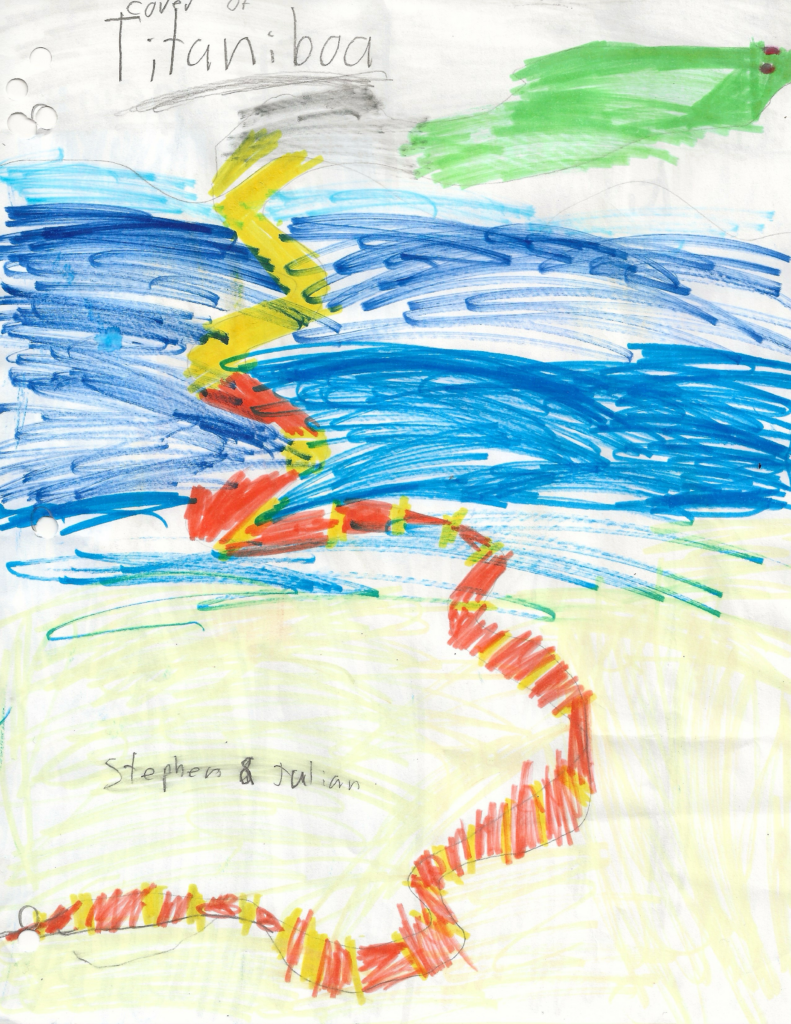
- He runs into the studio holding up a piece of paper shouting “STEPHEN! I MADE AN ALBUM COVER FOR MY SONG!!!” It is amazing and I love it.
- We spend this lesson enjoying our song and working on some more fundamentals. We learn song form definitions – intro, verse, chorus, bridge. We learn how to count in the band. We’re counting how many measures we play for the intro, how many for the verse before we transition to the chorus. We look at lyric cues and how they can help us navigate the form of a song. Most importantly, we jam and we have fun with it.
The difference
We are 4 lessons in. We’re finding the beat, we’re writing lyrics, we’re singing, playing guitar, playing drums, soon to be exploring the keyboard. And he’s PUMPED.
Could I have done this with a cover song? Of course! But would it have been as exciting? As dynamic? Would it have been as memorable?
Here we have this original work of art, and a brand new music student who now knows he’s capable of that. In fact, he’s just taking it for granted at this point. I submit that that is a fundamentally better lesson arc.
I should also mention that this was not a unicorn of a student. I have reproduced these results many, many times. This one was pretty magical, but it was not altogether unique. It brings me no end of joy to watch this transformation happen – when a student is creating for themselves and seeing all the possibilities that lie therein.
I believe we are all creative beings, that we’re meant to bring new stories and new works of art into this world. When you embrace that in your music lessons from the very beginning, it becomes a richer experience for everyone involved. Student, teacher and families alike.
Keep creating, and as always, keep climbing the mountain.
Leave a Reply